

Architecture of the Unseen: Decoding the Anthropocosm in The Temple in Man
Updated: May 16

In architecture, there are buildings we enter with our bodies, and buildings we enter with our consciousness.
Some spaces are designed to shelter, impress, organize, or perform. Others seem to operate on a deeper frequency, they do not simply contain life; they speak about life. They hold proportion, silence, rhythm, orientation, and symbol in such a precise way that the building becomes more than matter, it becomes a coded body.
This is the world opened by R.A. Schwaller de Lubicz, the French Egyptologist and mystic, in his book The Temple in Man, a provocative reading of the Temple of Luxor in Egypt. Based on years of study and observation, de Lubicz proposed that Luxor was not designed as a random accumulation of courts, halls, columns, and sanctuaries. Instead, he argued that the temple was conceived as a geometric and symbolic transcription of the human being.

The Temple in Man reveals sacred architecture as a living body, where the geometry of Luxor becomes a map of human proportion, cosmic order, and the unseen intelligence within form.
The Temple as a Human Body
In the book, the author argues that the plan of the Temple of Luxor corresponds to the proportions of a harmonious human skeleton. According to de Lubicz, this relationship is not a loose visual resemblance, it is an anthropometric structure, where different parts of the temple correspond to different parts of the body:
the covered temple becomes the region of the head and sanctuaries.
the first hypostyle hall corresponds to the chest
the threshold between the peristyle court and the colonnade aligns with the pubic region.
the long colonnade becomes the thighs., and the gate and colossi mark the knees.
even the extremities of the pylon are read as corresponding to the toes of the temple-body.

The human figure becomes architecture itself, carved in stone, framed by sacred columns, and aligned with the temple as a symbol of divine proportion, cosmic order, and anthropocosmic being.
Whether read as historical fact, esoteric interpretation, or symbolic architecture, the idea remains powerful: the temple becomes a witness to human identity. This shifts the role of architecture, as a building is no longer only an object in space, it becomes a mirror of being.
Architecture as Growth, Not Object
Another important layer in de Lubicz’s interpretation is time. The Temple of Luxor is not treated as a static monument, it is understood as a living organism that develops. Its construction phases, from Amenophis III to Ramses II, are interpreted as corresponding to stages in human growth: newborn, child, adolescent, and adult.
This idea is especially relevant to contemporary design thinking. Modern architecture often freezes the building at the moment of completion. The render, the handover, the final photograph, these become the official image of the project. But living architecture does not stop at completion. It changes through use, memory, aging, weather, ritual, and human interaction. It carries childhood, puberty, adulthood, transformation, and awakening within its geometry.
The Temple in Man invites a radical question: What if architecture is not only built around the human body, but built as the human body? Not metaphorically or decoratively, but as a living diagram of the relationship between matter, spirit, time, and consciousness.
Phi, Crossing, and the Geometry of Life
At the heart of de Lubicz’s reading is the Golden Number, Phi (ϕ), and what he describes as the principle of crossing.
In sacred geometry, Phi is often understood as a proportion of growth, balance, and harmony. It appears in natural systems and classical canons of proportion. In the context of Luxor, de Lubicz reads Phi as a vital principle of crossing: vertical and horizontal, spirit and matter, male and female, heaven and earth, axis and movement.
In this reading, birth into nature happens through the meeting of opposites. Architecture becomes the physical registration of that crossing.
This is where the Temple of Luxor becomes especially fascinating, its axes are not perfectly rigid or mechanically aligned, they shift and pivot. They create a subtle displacement that gives the stone plan a sense of becoming, and the temple feels alive because it is not a dead diagram.

Phi as living geometry, where the Golden Ratio becomes a bridge between natural harmony, sacred proportion, and digital intelligence.
The Crown of the Skull and the Architecture of Intelligence
De Lubicz suggests that the temple’s “head” ends at the headband, deliberately excluding the upper braincase.
Symbolically, the crown of the skull represents cerebral intelligence: the mind of comparison, analysis, choice, and rational judgment. Yet, in his interpretation, the temple points beyond this intellectual faculty toward another form of knowing: a direct, divine, or heart-centered intelligence.
This distinction is architecturally significant.
Modern design culture often prioritizes the cerebral: logic, function, data, and visual strategy. Sacred architecture, however, works differently. It does not only produce spaces to be understood intellectually; it organizes the conditions through which spirituality, presence, and inner perception can be experienced.
The Anthropocosm: Man as Temple, Temple as Universe
The most powerful idea emerging from The Temple in Man is the concept of the anthropocosm: the human being as a living reflection of the cosmos.
This is not the same as saying that man is the center of the universe in an egoistic sense, but that Man is meaningful because he is part of a larger order.
The body becomes a small universe, the temple becomes a large body, and the cosmos becomes the invisible law connecting both.
This idea challenges the reduction of architecture to function, image, or commercial value. It asks us to look again at proportion, ritual, orientation, material, silence, and symbolic sequence.
What does a building know about the body? A plan know about time? And most importantly: Can architecture help us connect to life?
Toward a Quantum Architecture of the Unseen
For WiEdesign, this reading of The Temple in Man is not about copying ancient Egyptian forms, but about understanding a deeper design methodology. Ancient sacred architecture teaches us to design from invisible structures: proportion, energy, memory, growth, consciousness, and human transformation.
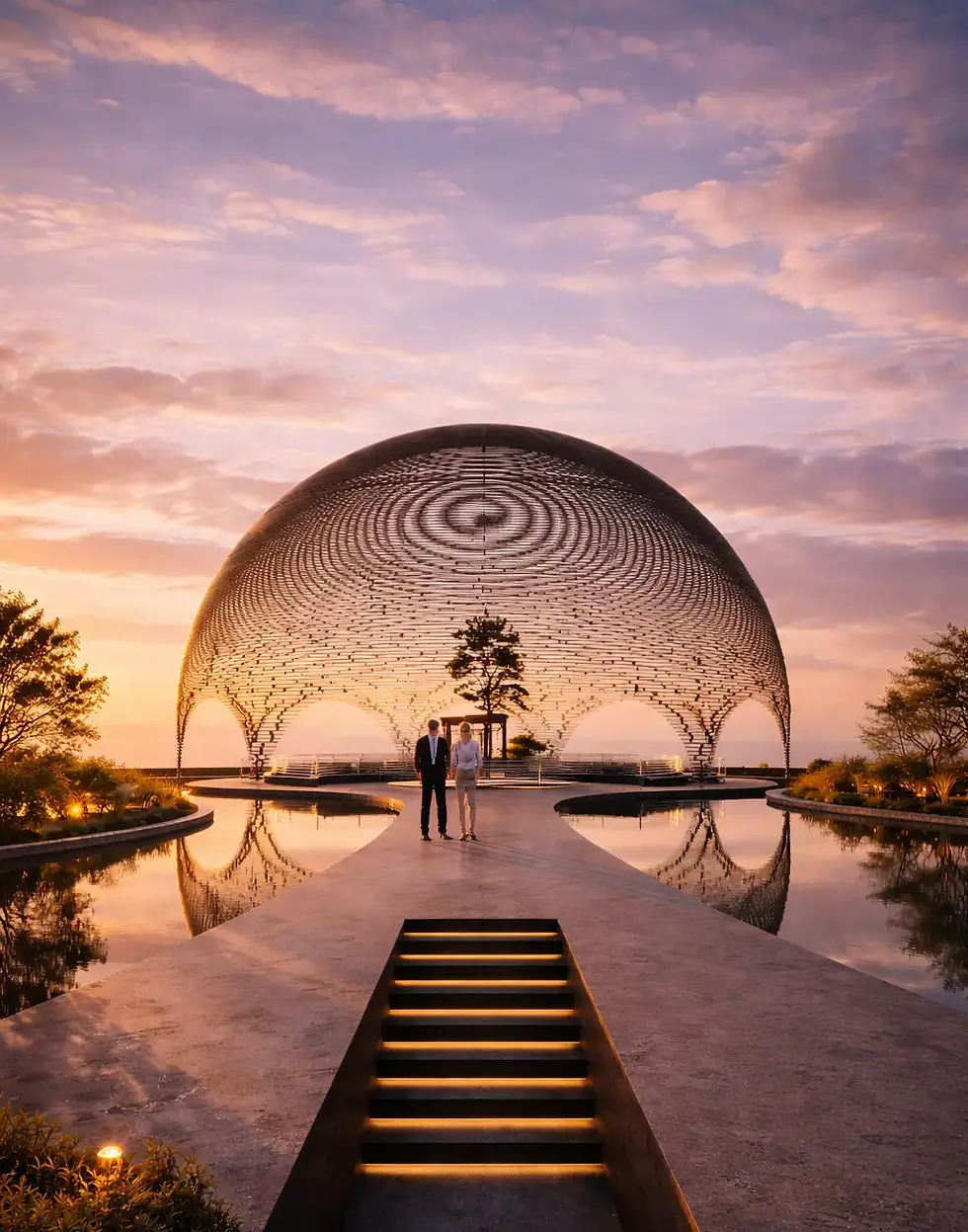
This is where the idea of Quantum Architecture becomes relevant. Architecture is no longer treated as a static object, but as a living field of relationships between body, matter, light, geometry, and meaning.


Comments