
• Human Centered Design

THE STITCHES
Community Center
The explosion that struck Beirut on August 4, 2020, prompted a reevaluation of the city's future within a larger master plan. The devastation led to the inception of The Stitches, a comprehensive Cultural Heritage Research Center, designed to unify various aspects of the city's history, memory, and identity.

Sector
Cultural
Status
Conceptual Design
Year
2023
Location
Beirut, Lebanon
Client
OEA
Architect
Farah Saab
Some projects begin with form.
The Stitches begins with fracture.
Conceived in the aftermath of the Beirut port explosion, the project responds to a city marked by rupture, not only physical destruction, but a deeper break in continuity between memory, public life, and the urban future.
As a Cultural Heritage Research Center, The Stitches is not designed as a static object of preservation, but as a civic framework that reconnects what has been separated. It positions heritage not as something frozen in the past, but as something active, shared, and continuously reinterpreted through public life.

The name is direct, and that directness is its strength. A stitch does not erase a tear. It acknowledges damage while refusing disconnection. It binds fragments without pretending they were never separate. That makes it a more honest architectural metaphor than the overused language of healing, resilience, or rebirth. Beirut is not “healed” by a single building. But it can be carefully, deliberately, reconnected.
This is the project’s emotional intelligence. It understands that the real damage after the blast was not limited to broken masonry and shattered glass. What was fractured was the relationship between people and the city they inhabited. Beirut’s cultural institutions, archives, and shared spaces had already been under strain; the explosion exposed how vulnerable that ecosystem had become. The Stitches responds by translating that condition into architectural method.

1 - System & Organization

2 - Axis & Urban Continuity

3 - Presence, Structure & Envelope
At the core of the project is the idea of stitching as an architectural act. A stitch does not erase a tear; it holds separate edges in relation. That logic defines the entire building. Rather than organizing the program into isolated parts, the project is conceived as a layered system of public, semi-public, and private volumes. Each layer has its own role and level of access, yet all are bound together within one coherent architectural system. This creates a clear operational hierarchy while maintaining continuity across the whole. The result is a building that accommodates difference without fragmentation, allowing multiple programs to coexist within a unified spatial structure.
This layered organization is reinforced by a central structural system that literally and conceptually stitches the volumes together. Structure here is not only technical; it becomes part of the project’s meaning. It links programs, stabilizes the composition, and transforms separate masses into a single civic organism. In this way, architecture becomes the medium through which reconnection is made visible.
The project’s relationship to the city is equally important. The volumes are strategically split along a city-to-waterfront axis, ensuring that the building does not interrupt visual or physical continuity across the site. Instead of occupying the ground as a closed block, the mass is lifted and displaced to create an active public plane beneath and around it. This move transforms the building into a transitional landscape rather than a barrier. It allows the project to mediate between city, memorial, and waterfront, preserving the openness of the site while introducing a strong civic presence.
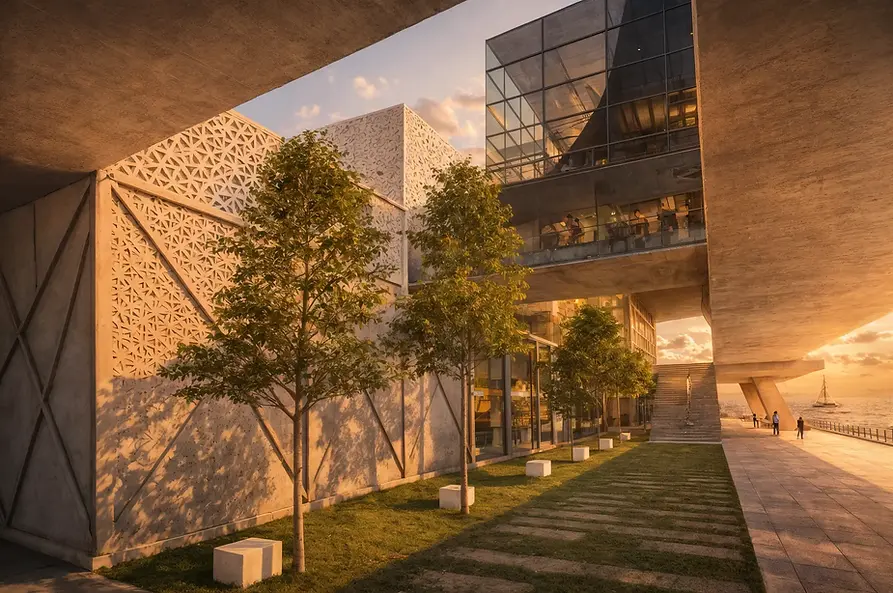
This urban strategy gives the building a dual role. On one hand, it stands as a clear institutional landmark; on the other, it remains porous and connected to public movement. The architecture does not isolate itself from the city. It extends the public realm and invites it into the project, making the ground level a place of encounter, passage, and continuity.
The envelope develops this idea further. The mesh skin is shaped by the building’s dual response to its context: it descends toward the memorial in acknowledgment and rises toward the city in resilience. More than a formal gesture, the envelope works as an environmental and experiential filter. It controls light, exposure, and the relationship between the exterior and the glazed inner volume, producing a facade that is both expressive and performative. The building shifts in character through light and shadow, balancing opacity and transparency in a way that reflects the tension between remembrance and renewal.
What defines The Stitches is its refusal to rely on symbolism alone. Its meaning is not carried by image, but by system, hierarchy, axis, structure, and envelope. The project becomes powerful because it performs reconnection rather than simply representing it.
In this sense, The Stitches is more than a response to destruction. It is a proposal for continuity, an architecture that lifts public life, reorders fragmented programs, and creates a space where heritage, community, and the future can once again exist in relation to one another.


