

Architecture in Times of War: When Space Becomes Witness
Updated: Apr 17
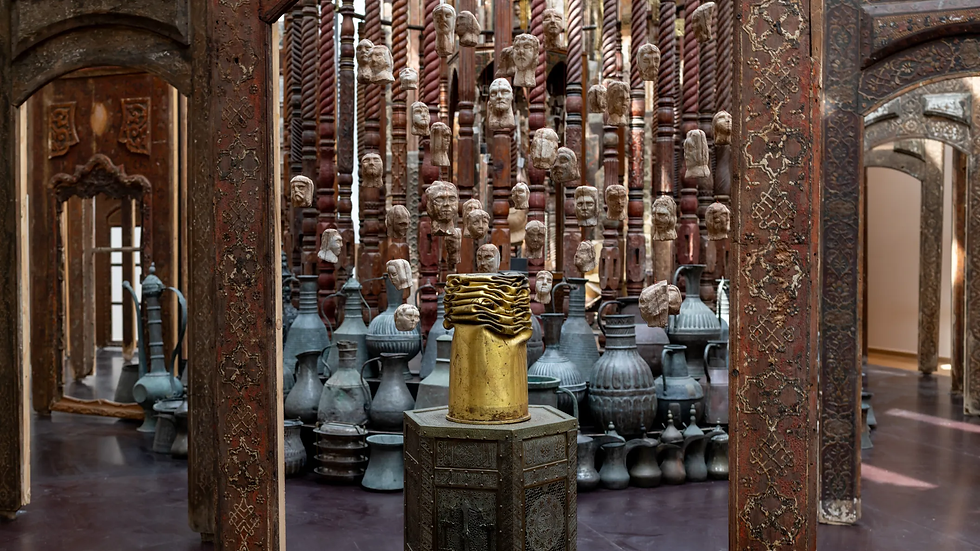
War does not only destroy cities, it alters the meaning of space itself.
In times of war, architecture is among the first to lose its definition. Not its form, its definition. Walls remain standing, rooms still exist, buildings continue to occupy ground, but the relationship between space and life collapses.
A home is no longer a home, a wall is no longer protection, and a room is no longer intimacy.
The very elements designed to shelter become unstable, unpredictable, sometimes even lethal. Spaces once shaped by routine, memory, and daily life are suddenly redefined by risk. What was familiar becomes exposed and what was safe becomes uncertain.
This is the deeper rupture of war: not only the destruction of buildings, but the dismantling of architecture’s purpose.
Architecture as Witness of War
In that altered state, architecture takes on another role: it becomes evidence with a fractured façade, a burned structure, or a deserted street. It holds history in its material condition, narrating and revealing. Every crack, every absence, every exposed layer becomes a trace of an event that has taken place. Not interpreted, not filtered, but simply present.
Some buildings continue to carry the weight of what occurred within them. Others resist neutrality altogether. Even when restored or repurposed, they remain marked. The physical environment does not forget easily, and In this sense, architecture becomes a form of archive, one that cannot be edited.

Hiroshima Peace Memorial cenotaph aligned with the Genbaku Dome, with floral tributes in the foreground.
Before the war:
Industrial Promotion Hall
1945:
Atomic bomb explosion
After the war:
Left exactly as it stood after the blast
Transformation:
From administrative building to global anti-war symbol
The building is not repaired because repair would erase truth
It carries violence embedded in material.
It is no longer architecture in the traditional sense, it is evidence in space
The Problem of Preservation
But if architecture records history, it also raises a difficult question: should everything be preserved?
Not all spaces deserve permanence.
Certain environments continue to reproduce harm long after the conflict has ended. Some structures embed violence into their spatial logic through confinement, exposure, control, or erasure. Preserving them without transformation risks extending their impact.
There are moments when intervention becomes necessary, not to erase history, but to reframe it.
To dismantle, to adapt, or to reconstruct can be a way of interrupting cycles embedded in space. Architecture, in this sense, must be allowed to change, not to forget, but to prevent repetition.
Memory without responsibility becomes static and responsibility requires action.

Berlin Wall covered in colorful murals, with the cleared border strip stretching beside it through a cold, divided urban landscape.
Before:
Political infrastructure enforcing division
During Cold War:
Spatial control mechanism
After 1989:
Partially demolished, partially preserved
War as the Collapse of Ethics
The most critical dimension of war is not physical destruction, it is ethical failure.
When architecture is shaped by power, fear, and ideology rather than responsibility, it becomes instrumentalized. It shifts from serving life to enforcing control.
Space becomes a tool, buildings become mechanisms, and cities become strategies.
This is where architecture loses its grounding. Because architecture, at its core, is not neutral, it organizes human experience, and defines access, movement, visibility, and protection.
Even in its most constrained typologies, borders, prisons, infrastructure, it must remain accountable to human dignity.
Once that accountability is removed, architecture no longer serves people.It serves force.

Beirut Holiday Inn Hotel, rising above the street, standing as a lasting ruin of the Lebanese Civil War.
1974:
A 26-storey luxury hotel in Beirut's seaside hotel district.
During Lebanese Civil War:
Strategic vertical territory for snipers, surveillance, and artillery positioning.
One of the most symbolic battlegrounds of the conflict.
After The War:
Abandoned ruin standing in a bullet-ridden, hollowed-out state, suspended between ruin and redevelopment.
A frozen witness to Beirut’s civil war, carrying the violence of the conflict in its concrete shell
Aftermath: What Remains
There is no resolution in war, only residue with destroyed structures, displaced populations, altered landscapes, and interrupted histories.
And architecture remains carrying all of it not as symbol, but as condition.
It reflects the scale of what has occurred without needing explanation. It holds the physical consequences of decisions made beyond its control. And in doing so, it becomes a continuous reminder of what took place.

Beirut’s Museum of Memory is a restored war-scarred heritage building, its bullet-marked façade preserved to tell the story of Lebanon’s civil war.
Toward Responsibility
The question is not how architecture survives war, it always does, one way or another, he question is how it is approached afterward.
Reconstruction is not only technical, it is ethical, and it requires decisions about what to keep, what to remove, and what to redefine. It demands clarity about the kind of environments that should emerge from conflict.
Architecture cannot prevent war, but it can refuse to perpetuate its logic.
It can be used to re-establish stability, to restore clarity between space and life, and to rebuild environments that prioritize human presence over control.
A fractured façade is no longer just a façade… it becomes a record.
Because ultimately, architecture is not only a physical act, it is a decision about how people are allowed to exist within space.
And in times shaped by conflict, that decision becomes critical.


Comments