• Human Centered Design

LEONARDO PLAYGROUND
Public
Cities usually hide their infrastructure once it stops working. Milan did something stranger: a forgotten canal becomes a new public ground for play, discovery, and civic activity, reconnecting historical infrastructure with contemporary city life.

Sector
Public
Status
Design
Year
2025
Location
Milan, Italy
Client
Milan Design Week
Architects
Equipo Mazzanti
Farah Saab
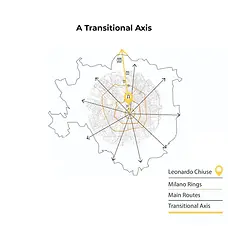
The Chiuse Leonardesche sits inside the city like an urban leftover, part canal, part memory, part absence. It is historically loaded, spatially dramatic, and functionally disconnected, trapped between the traditional city and the contemporary one, along a transitional axis running from the Duomo toward Porta Nuova.
The project begins by refusing to treat that condition as a problem to be solved through beautification. Instead, it asks a sharper question: what if the canal is not a void in the city, but a ground of possibility? What if the forgotten cut could become a surface of activity?


That is the intelligence of Playground.
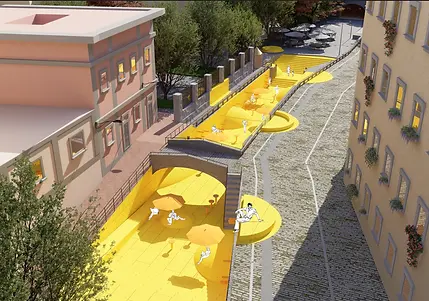
Rather than reconstructing the canal as a nostalgic object or filling it with a single-purpose program, the proposal introduces a new urban layer above it: a flexible, inhabitable topographic surface that covers and activates the site while allowing its hidden depth to remain legible. The project condenses this into a simple line—“We cover, you discover.” It is both slogan and strategy. A lightweight plug-in intervention stretches across the canal, not to erase it, but to make it socially productive again. The canal remains present underneath as history, while above it a new public ground emerges as invitation, encounter, and event.
This move is less about architecture as object than architecture as urban catalyst. The proposal reads the site not in isolation, but within a broader system of Milanese movement and urban identity. Diagrams in the presentation position the intervention within Milan’s concentric rings and main routes, locating the Chiuse Leonardesche as part of a larger city-to-city transition between historic Milan and the emerging contemporary landscape around Porta Nuova. The project understands the canal as a hinge: a compressed urban threshold where multiple speeds, publics, and atmospheres meet. Instead of smoothing out that tension, it intensifies it productively.


The result is not a park in the conventional sense, nor a bridge, nor a pavilion, though it borrows something from all three. It behaves more like an urban instrument. The intervention attracts, covers, and organizes. It creates a continuous yellow surface—a new topography of play and discovery—that plugs into the canal as a civic device. Understood this way, “playground” is not a childish label but a serious urban proposition. Play becomes a method for reclaiming overlooked infrastructure. Discovery becomes a way of re-entering the city. Activity becomes the proof that public space is alive.
This is why the project’s programming is deliberately open. The surrounding neighborhood already contains a mix of residential life, ateliers, exhibitions, craft workshops, restaurants, schools, markets, and community spaces. Rather than competing with those functions, the proposal amplifies them by creating a shared surface where artifacts, installations, movement, and gathering can happen. The canal becomes a platform for temporary events, spontaneous use, and public interaction. It is urban acupuncture rather than monumentality: small in footprint, strategic in effect.


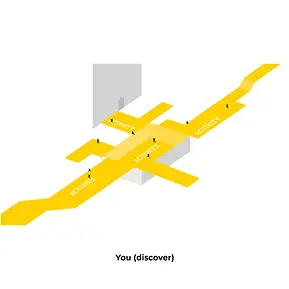
Formally, the project is almost disarmingly direct. The new surface folds across the site, producing moments of compression, pause, widening, and release. Circular nodes punctuate the linear sequence, acting as attractors along the route. The geometry is not arbitrary; it is shaped by movement, adjacency, and the need to turn a residual corridor into an active civic spine. This gives the project a particular elegance: it is at once infrastructural and playful, minimal and performative. It does not overload the site with architecture. It gives the site just enough structure to begin producing urban life again.
What makes the playground compelling, finally, is its attitude toward the past. It does not sentimentalize the canal, nor does it bury it beneath a cleaner contemporary image. It accepts that heritage can remain incomplete, partially hidden, and still intensely present. The project does not ask the city to look backward. It asks it to rediscover what is already there by moving differently across it.
In that sense, the proposal is less about a canal than about a city learning to use its own scars more intelligently. Milan does not need every forgotten infrastructure to become a museum piece. Sometimes it needs them to become public again. Playground understands that difference, and turns it into design.