
• Human Centered Design

GAIA
Private Residence
Even Architecture Can Begin with Light. Some houses begin with a facade. Others begin with a floor plan. A few begin with an image of lifestyle. GAIA begins somewhere quieter.

It begins with the belief that light is not an accessory to architecture, but one of its first materials. Not something added after mass, structure, and envelope have already been resolved, but something capable of shaping atmosphere, movement, and emotional memory from the beginning. In this project, light is not treated as illumination. It is treated as substance. It defines the house less through color than through presence: clarity without harshness, softness without vagueness, restraint without absence.
That choice changes everything.
One phrase in the project says it precisely: light begins from within, then exterior follows.
Instead of relying on monumental gestures or unfamiliar form-making to produce meaning, the architecture allows meaning to emerge through experience. Water, sun, stone, glass, shadow, air, and passage do the narrative work. The house does not impose a story on its inhabitants. It creates the conditions for one to appear. The people inside complete it.There is something deeply disciplined in that position. In a time when residential architecture often performs for the image before it performs for life, GAIA turns inward first. One phrase in the project says it precisely: light begins from within, then the exterior follows. That is not just a poetic line. It is the governing logic of the whole composition. The house is conceived from the inside out, from lived perception toward built expression, so that the architecture reads not as an object placed on land, but as an atmosphere unfolding through it.


Formally, the project moves through slabs, bridges, stairs, terraces, mass and void. But these are not assembled as isolated sculptural moves. They operate as a sequence of relationships. Architecture here is understood in its most essential sense: connecting what is separate and giving meaning to the in-between. The bridge is not simply circulation. It is threshold. The stair is not simply access. It is transition. The opening in a wall is not an interruption of enclosure, but a calibrated revelation of the next spatial condition.
This is where the project’s alignment with the legacy of White Architecture becomes important. The palette is restrained: soft white planes, warm wood, clear glass, mineral surfaces, water, and light. But restraint here is not minimalism for its own sake. It is precision. By reducing noise, the project gives greater intensity to reflection, shadow, sky glow, and material warmth. White surfaces receive daylight. Timber absorbs it. Glass extends it. Water unsettles it, carrying light into motion and memory.
Water, in particular, is central to the emotional intelligence of the house.
GAIA is not trying to be louder than its context. It is trying to be more awake within it.


In GAIA, water is never treated as a singular feature or decorative endpoint. It appears between spaces, along edges, within transitions, beside moments of pause. It accompanies movement rather than stopping it. This matters because it allows nature to remain continuous with architecture. The house never arrives at a dead end. Instead, water occupies the in-between, cooling the present, softening thresholds, and transforming circulation into experience. Reflection becomes a spatial device. Sound becomes temporal texture. Motion becomes memory.
The same continuity defines the interior. Rather than reading as a collection of enclosed rooms, it is conceived as a light landscape. A skylight anchors the house to the sky, drawing daylight deep into the section and making time visible across surfaces. Greenery and voids prevent solidity from becoming heaviness. Openings connect without exposing. Privacy is preserved not through blunt separation, but through spatial intelligence. The result is a home that feels whole without becoming uniform, and intimate without becoming closed.
This is perhaps the most compelling quality of GAIA: it understands domestic architecture as choreography rather than composition alone. The house is not only seen. It is crossed, felt, reflected in, filtered through, and remembered. Its order comes from layers: ground, water, sky; mass and void; energy and flow. Even the project’s design language suggests that the heart of the house is not a room in the conventional sense, but a kind of vortex of light—a center defined less by geometry than by presence.
And from that interior logic, the exterior gains its force.


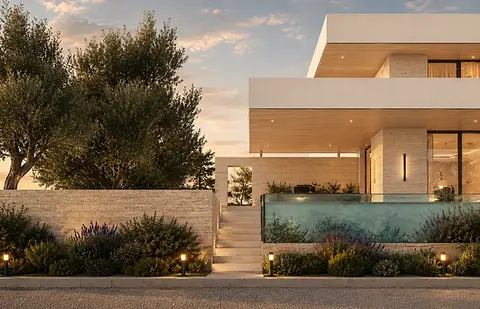
The facade is not conceived as a detached skin but as an artistic continuation of the house’s inner life. “Gaia in Light Motion,” as the project names it, turns the elevation into a floating, perforated, light-responsive layer: part installation, part sculptural element, part atmospheric instrument. It receives the sun by day and releases light from within by night, allowing the house to shift character without losing coherence. The facade does not decorate the architecture. It reveals its story.
In the end, GAIA is not trying to be louder than its context. It is trying to be more awake within it.
It proposes that a house can be gentle and still exacting. Quiet and still memorable. Restrained and still deeply alive.
Not because it says more.
Because it knows what to let light say for it.


